Overview
The human body is an amazing and complex entity, renewing itself on an endless basis. Three of the more fascinating components of the body are the skin, hair and nails.Skin
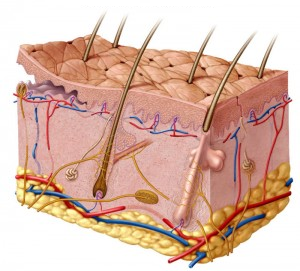
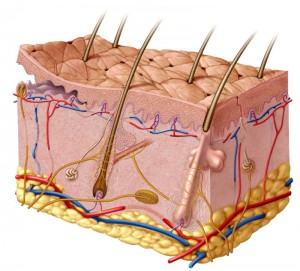
Very few of the body’s many parts renew themselves more quickly than the skin. The skin has two distinct, main layers. The outer layer is called the epidermis, whose main function is that of providing protection for the body. The underlying layer is called the dermis. Each and every month the body’s outer layer of epidermis is completely shed, at an amazing rate of some 30,000 dead cells every 60 seconds.Thousands of sensors which are sensitive to touch are found in the dermis. Sweat glands and blood vessels are also contained in the dermis, playing an extremely vital role in regulating the body’s temperature. Directly under the dermis is a layer of subcutaneous fat, acting as a buffer and providing insulation for the body against extremes of both cold and heat.
The skin can be viewed as a mirror-image of one’s health, reflecting an individual’s lifestyle and diet. Research has shown that external factors as well as internal disorders and diseases can have a direct influence on the health of the skin, creating such disorders as sores, spots and rashes.
Skin growth can also be attributed to exposure to hazardous radiation, ultraviolet light, or toxic chemicals.
One of the largest organs of the human body, each individual’s total skin weighs in at approximately 3 to 5 kg, or 6 to 9 pounds. Typical surface area of a person’s skin is 2m squared, or 21 square feet. The skin is formed from several different types of cells, some of which produce hair and the tissue that becomes fingernails and toenails.
Many people believe the skin is merely an ultra-thin, waterproof covering for the body. Nothing could be farther from the truth. The skin is actually a very complex organ made up of a wide variety of highly specialized cells. Skin comes in varying thickness, from about 0.5mm on areas such as the eyelids to 5 mm or more on those areas which experience greater wear and tear, such as the soles of the feet.
Nails
Not much thought is typically given to how the body forms fingernails and toenails. However, this complex process is the result of hard “plates” being formed by the protein known as keratin. A fold of flesh called a cuticle is where the nail growth takes place, as the nail matrix continues to add keratinized cells to the root of the nail. The entire nail is continuously pushed upward along the bed of the nail toward the nail’s free edge. Typical growth for a nail is around 0.5mm each week, although fingernails do have a tendency to grow at a faster rate than toenails.Hair
What is a hair? A hair is a rod of dead cells which is filled with keratin. The bulb of the hair (also called the “root”) is essentially buried in a pit called a follicle. The hair lengthens as more and more cells are added to the root. While the body has many different kinds of hair, hairs on the scalp grow about 0.33mm each day. After a period of three or four years, the follicles enter a phase of rest in which the hair may fall out. Some three to six months after entering the rest period, the follicle becomes active again and begins to produce new hair.Other Functions
It is easy to understand that the skin is the body’s first line of defense to anything which may cause it harm. With its supple and “cushioning” qualities, the skin is well equipped to help prevent potential physical damage. Although the skin cells which form the outer layers are very tightly woven together, a certain degree of pliability does exist.Each skin cell contains enough of the protein keratin to fend off attacks by many different types of chemicals which may come in contact with the skin. Millions of sebaceous glands, each tied to a hair follicle, secrete sebum, an oily substance which provides the skin with natural antibiotic and water repellant qualities. This secretion serves to inhibit the growth of some microorganisms and also prevents the hair on the body from becoming brittle.
Regulating a consistent temperature in the body is yet another function of the skin. In this important process, blood vessels in the dermis widen when the body is too hot, allowing extra blood flow so additional heat can leave the surface of the skin. Sweat glands also produce more sweat during times of fever, causing evaporation, which also draws away body heat.
When the body is too cold, the blood vessels in the skin constrict, minimizing sweating and heat loss. The arrector pili muscles also pull tiny hairs on the body to an upright position to trap an insulating layer of air, thus helping to preserve heat.
The dermis also controls another important bodily function – the sense of touch.
The nerve endings on very small nerve cells in the dermis are able to detect various physical changes, ranging from very light contact to intense or painful pressure. A patch of skin the size of a fingernail typically contains around 1,000 different receptors. The skin on the fingertips, however, contains more than 3,000 receptors, allowing an individual to feel the most delicate touch.
Nerve impulses are generated due to deformation of the receptor’s layers, as well as contraction or expansion of the dermis due to changes in temperature. These impulses travel along the nerve fiber in the receptor, joining other bundles of nerve fibers in the layers below the dermis. Receptors typically “fire” their nerve signals on an infrequent basis when no stimulation is present, and increase the rate of nerve firings when the skin is touched.


 Posts
Posts